Northridge homes built before and after the 1994 earthquake often feature below-grade spaces with concrete slabs or partial basements that sit on the valley's clay-heavy soils. When winter storms drop several inches of rain in a short window, water migrates along Reseda Boulevard corridors and into Northridge East and Northridge West foundations. Hot Mediterranean summers that follow accelerate mold growth on drywall and carpet once temperatures climb above 90 degrees, so extraction must be paired with targeted dehumidification to keep moisture below 50 percent relative humidity.
Technicians start by isolating electrical circuits and removing standing water with submersible pumps before any structural drying begins. In older Northridge West properties, lath-and-plaster walls absorb water differently than modern drywall, requiring moisture meters to map hidden saturation behind baseboards. Crews also check for compromised sewer lines common in 1960s-1970s tract homes near the CSUN campus, because floodwater mixed with effluent demands full containment and disposal rather than simple pumping.
After water removal, industrial air movers and desiccant dehumidifiers run continuously for several days while crews monitor wood framing and concrete for residual moisture. Homeowners in Granada Hills and Porter Ranch frequently request documentation for insurance adjusters, so daily moisture logs and photo records are standard. Final steps include HEPA vacuuming of settled silt and application of antimicrobial treatments only where porous materials cannot be fully dried within 48 hours.
Technician insight
In Northridge the thing that catches most people out with basement flood cleanup is how the valley's clay soil holds water against 1950s-1970s foundations near Reseda Boulevard long after the rain stops, so homeowners who only run a shop vac end up with hidden mold once summer heat hits.
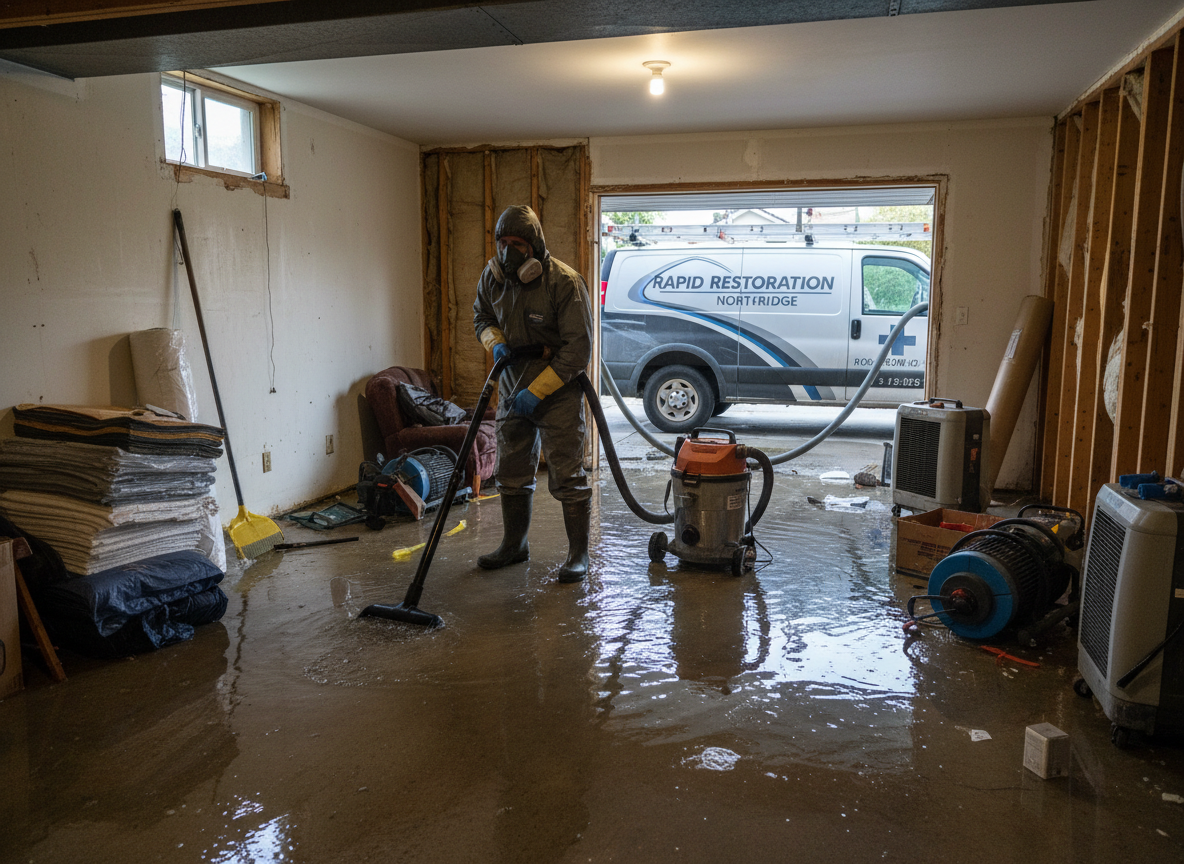
Winter runoff into Northridge East lower level
Heavy January rains sent water across a sloped driveway into a Northridge East home near the CSUN campus. Technicians found saturation in the concrete slab and lower drywall. Extraction and continuous drying prevented mold growth before the next heat wave.
How it works
- 1
Site Assessment
Technicians inspect the basement, map water intrusion points from storm drains or foundation cracks, and test moisture levels in walls and floors.
- 2
Water Extraction
Industrial pumps and wet vacuums remove standing water while protecting electrical systems and separating any contaminated effluent.
- 3
Drying and Dehumidification
Air movers and dehumidifiers run until moisture readings in concrete, framing, and drywall return to normal levels for the San Fernando Valley climate.
- 4
Cleanup and Documentation
Remaining silt is removed, antimicrobial agents applied where needed, and daily logs prepared for insurance claims.
Pricing
Cost depends on water volume, affected square footage, and whether sewage contamination is present; upfront quotes provided after on-site assessment.