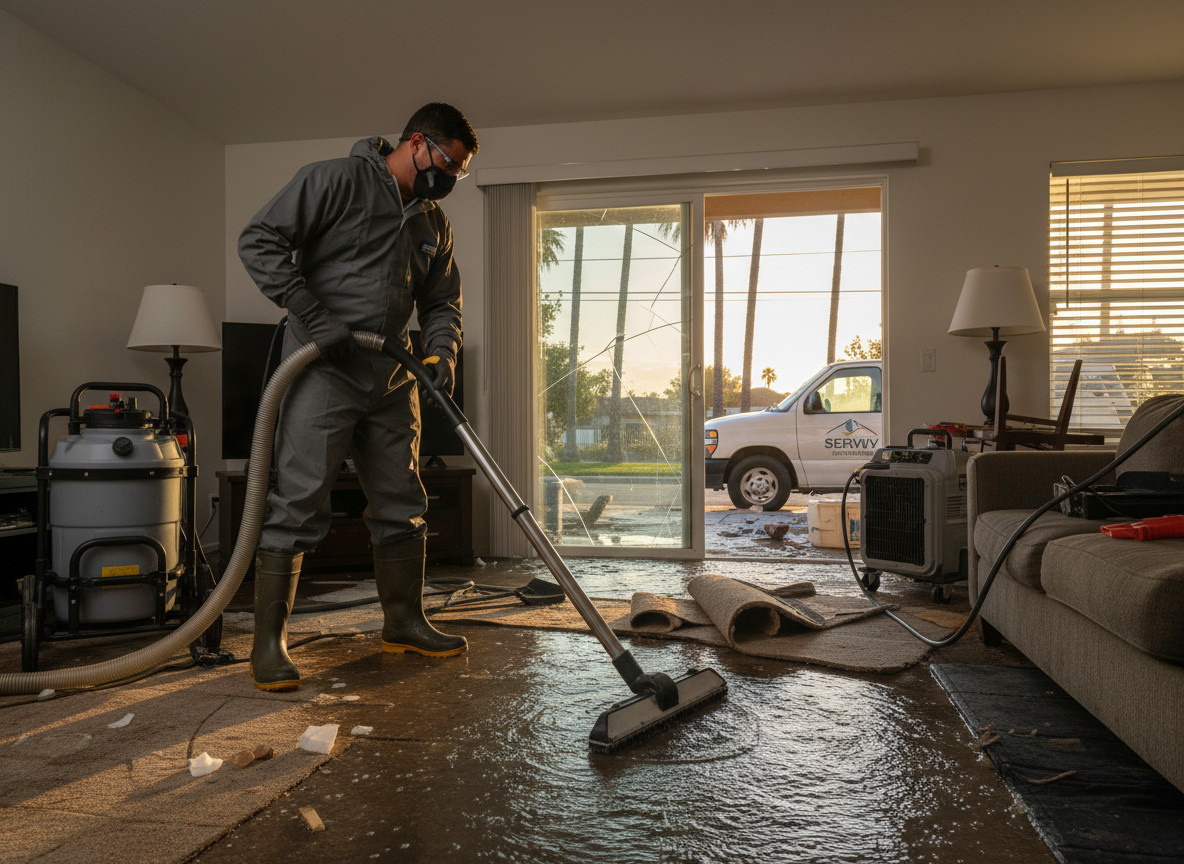
Northridge properties often sit on older plumbing runs installed decades ago, especially in Northridge West and around the California State University Northridge campus. When a supply line fails, water can travel quickly under slab foundations or through stucco walls common to the area. Emergency water removal crews must map moisture migration immediately because the Mediterranean climate keeps summer humidity low enough that surface drying masks deeper saturation in subfloors and wall cavities.
Hot summer temperatures accelerate evaporation from standing water on Reseda Boulevard commercial strips and in single-family homes near Northridge Fashion Center, but they also increase the risk of rapid mold growth once moisture is pulled from porous materials like oak flooring or drywall. Technicians use extraction wands rated for high volume followed by air movers positioned to push dry air across affected zones without disturbing settled dust in older Northridge East residences.
Los Angeles County code requires proper disposal of contaminated water and documentation of moisture readings before any reconstruction begins. In neighborhoods bordering Chatsworth and Granada Hills, crews frequently encounter irrigation line failures that saturate clay-heavy soil, allowing water to wick back into stem walls days after the initial event. Skipping thorough extraction at this stage leads to recurring issues under cabinets and along baseboards.
Porter Ranch hillside homes present additional challenges because gravity pulls water toward lower levels and garages. Emergency water removal here includes protecting electrical panels and removing water from under raised floors before it reaches neighboring units.
Technician insight
In Northridge, the thing that catches most people out with Emergency water removal is how the clay soil around Northridge East and older homes near Reseda Boulevard holds water against foundations long after the visible puddle is gone, so stopping at surface extraction leaves moisture that later migrates back into walls.
Burst supply line under kitchen slab
A homeowner in Northridge West called after water appeared along the baseboard near California State University Northridge. We located the leak under the slab, extracted several hundred gallons, and ran drying equipment for four days until meter readings matched the rest of the house.
How it works
- 1
On-site assessment
Technician arrives within the service window, locates the water source, and uses moisture meters to chart affected materials in Northridge structures.
- 2
Water extraction
High-capacity pumps and wands remove standing water from floors, carpets, and cavities while protecting unaffected areas.
- 3
Drying and monitoring
Industrial air movers and dehumidifiers are placed; daily readings track moisture reduction until levels match unaffected zones.
- 4
Documentation and handoff
Photos, meter logs, and a written summary are provided so the property owner can coordinate with insurance or contractors.
Pricing
Cost depends on the volume of water, number of affected rooms, and whether hidden cavities or slab leaks are involved.