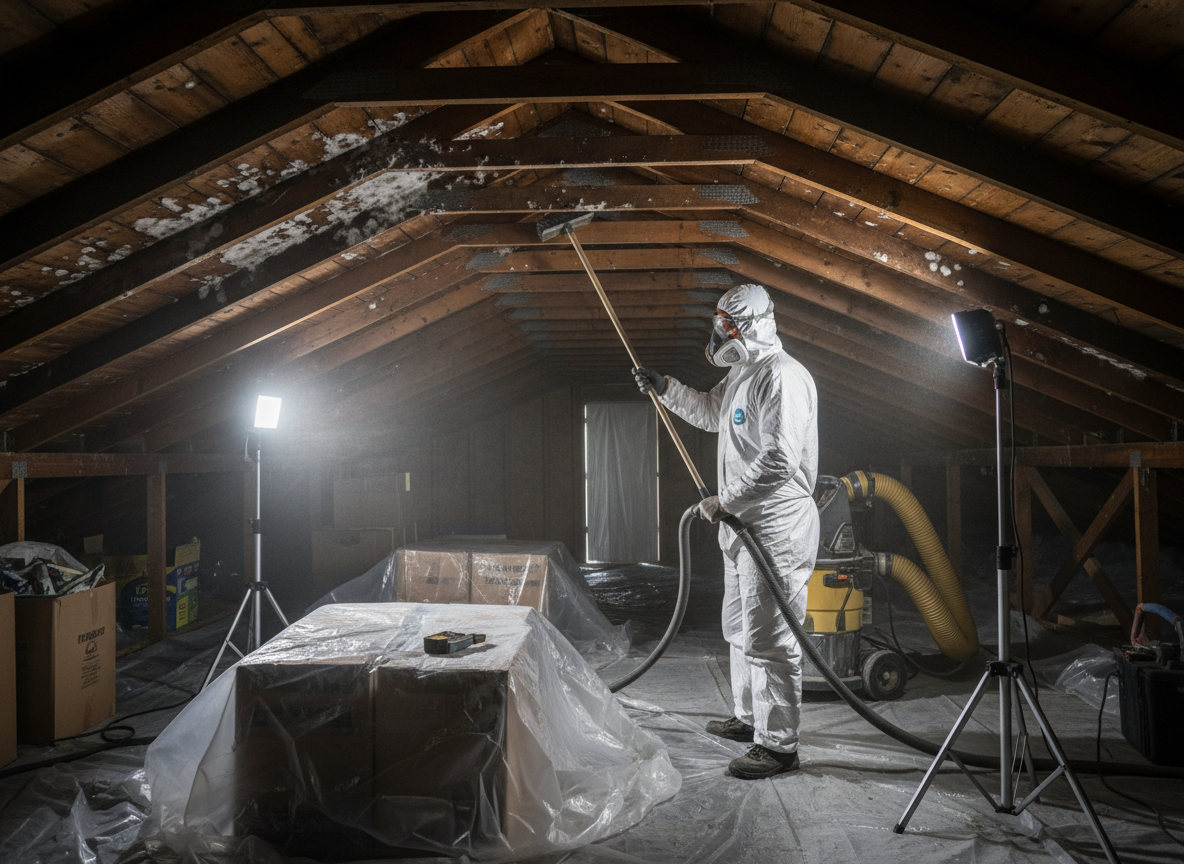
Northridge attics in 1950s to 1970s homes near Reseda Boulevard and the California State University Northridge campus commonly trap moisture from roof penetrations and bathroom exhausts. Mediterranean summers push warm air upward, creating condensation on cooler roof decking that soaks fiberglass batts and OSB sheathing. Remediation starts with negative-air containment to keep spores from drifting into living spaces below, followed by HEPA vacuuming and removal of saturated insulation that cannot be dried in place.
Edge cases appear when mold reaches HVAC ducts routed through the attic or when cellulose insulation has been added over older material. In those situations crews must seal registers, pull back multiple layers, and treat rafters with antimicrobial solutions rated for porous surfaces. Los Angeles County building practices from that era often left minimal ridge venting, so any remediation includes adding or enlarging vents to meet current airflow standards and reduce future risk.
Homeowners in Northridge East and Northridge West frequently discover the issue only after ceiling stains appear or during pre-sale inspections. Delaying action allows spores to migrate through recessed lighting cans into wall cavities. Technicians always test surface moisture in adjacent rooms and document hidden growth with borescopes before any demolition begins.
Post-remediation clearance requires both visual inspection and air sampling to confirm spore counts match outdoor baselines. Replacement insulation must be installed with proper baffles to maintain ventilation channels, especially on homes with low-slope roofs common along Porter Ranch boundaries.
Technician insight
In Northridge, the thing that catches most people out with attic mold remediation is how the hot summer heat drives bathroom moisture straight into the attics of 1960s tract homes near Reseda Boulevard and the CSUN campus, soaking insulation that never dries because original ridge vents were never added.
Hidden Growth in Northridge West Attic
A homeowner near Northridge West reported musty smells after a summer heat wave. Inspection revealed roof leak water had soaked cellulose over older fiberglass near the ridge. Crews contained the space, removed all wet insulation, treated rafters, and added ridge venting before reinstalling new material.
How it works
- 1
Initial Assessment
Technicians arrive within hours, map moisture sources with meters, and identify all affected insulation and sheathing in the attic space.
- 2
Containment Setup
Plastic barriers and negative air machines isolate the attic from the rest of the Northridge home to prevent spore migration.
- 3
Removal and Cleaning
Saturated materials are bagged and removed, rafters are HEPA vacuumed and treated, and any HVAC components in the attic are sealed and cleaned.
- 4
Drying and Verification
Industrial air movers and dehumidifiers restore dry conditions, followed by post-remediation air sampling to confirm clearance.
- 5
Ventilation Upgrade
Ridge and soffit vents are added or enlarged where needed to address the limited airflow typical in local 1960s construction.
Pricing
Pricing varies with attic size, depth of insulation removal, and any HVAC involvement.